

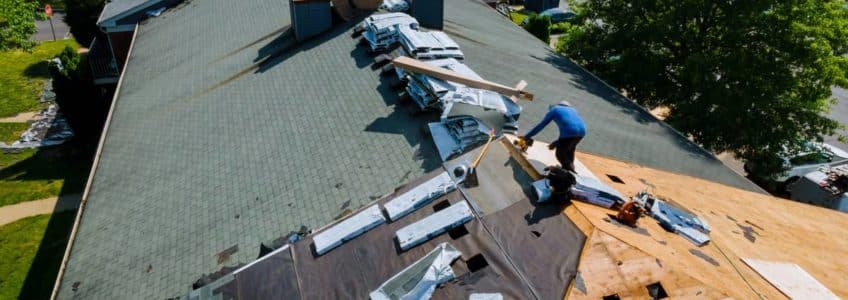
More than half of St. Paul’s single-family and small multifamily houses went up before 1930, and on a re-roof, that decides more than the shingle you choose. A house from that era was sheathed with spaced one-inch boards rather than plywood, so the tear-off routinely turns up a sheathing overlay nobody priced. The attic may have no soffit venting, because the house was built without any. The chimney is brick, which means counterflashing is cut into the mortar rather than caulk over the top.
Insurance is where that gets expensive. An adjuster writes a scope for the roof that was damaged rather than the roof the code now requires, and on an older St. Paul house the gap between those two numbers is where the argument happens. This guide compares ten top roofing companies in St. Paul on how they handle that, from storm restoration firms to the slate and tile specialists that older houses here sometimes need. Advantage publishes this list and places itself first for combined storm restoration and claim assistance; the order reflects our editorial judgment, not independently measured claim outcomes.
St. Paul’s Older Homes Need More Than a Shingle Estimate
The housing appendix to Saint Paul’s 2040 Comprehensive Plan reports that 57% of single-family, duplex, and triplex structures were built before 1930, with development of those types peaking in the 1920s. A house’s age does not establish its roof’s age, but it makes questions about previous replacements, board decking, and flashing especially useful.
The claim challenge is identifying what caused the damage. Travelers explains that aging, blistering, cracking, and granule loss can resemble hail damage. Ask for photographs and written findings distinguishing suspected storm impacts from deterioration, plus the reasons for recommending repair or replacement.
Why Older St. Paul Claims Get Short-Paid
Most Minnesota policies pay in two stages, and how the two payments actually work is worth understanding before you hire anyone. The short version: the first check is depreciated, the remainder is released after the work is finished and documented, and some policies release nothing at all. Homeowners who do not know about the second check sometimes hire against the first one and never claim the rest. Ask any contractor for both figures separately and in writing.
The second gap is code. An adjuster prices the roof that was damaged, not the roof the city now requires, and on an older house, that difference runs to decking, ice barrier, and ventilation work that was never part of the claim. Whether any of it gets paid turns on ordinance or law coverage, a separate limit on your policy that is sometimes a small percentage of the dwelling amount and sometimes nothing at all. Pull your declarations page and look for it before the tear-off rather than after.
When you take bids, ask for dated photographs, the affected roof areas, repair quantities, and the reasoning behind any decking or flashing work, kept separate from the insurer’s coverage decision. Two Minnesota laws also matter before you sign. A contractor offering to absorb or rebate your deductible is proposing something prohibited under Minn. Stat. § 325E.66, with exposure up to $10,000 per violation. And under Minn. Stat. § 326B.811, you may cancel a storm-repair contract within 72 hours of learning your claim has been denied. If you are denied, ask the insurer for the written reason and the policy language behind it.
How We Compared St. Paul Roofing Companies
We reviewed the companies’ published roofing services, storm-restoration processes, claim-assistance information, and St. Paul service or project evidence, using the same method we applied to our East Bethel list. We gave the greatest emphasis to hail-damage documentation, roof replacement, and insurer coordination, followed by older-home considerations and relevant roofing materials.
Advantage Construction publishes this guide and is our first recommendation for its combined storm restoration and insurance claim assistance. Several companies offer similar support. The order reflects editorial judgment based on public information; it does not compare claim approval rates or represent an independent audit of every company’s credentials. Confirm current licensing, insurance, and project-specific services before hiring.
How to Check and Verify A Contractor
Four checks, about ten minutes, and they work on every company here, including us. Start at the state’s license and registration lookup.
- License: Choose “Continue as guest” and search the company name. Status must read “Issued.” Minnesota uses three classes and the difference matters: BC covers new construction and remodeling, CR covers work on existing structures, and RR covers roofing only. An RR holder cannot contract for gutters, soffit, or fascia.
- Complaints and government actions: Open the BBB profile rather than the directory listing, because the two sometimes disagree, and look near the top for a Government Actions block. That is where state consent orders appear.
- Enforcement history: Search the company name, and any trading name it uses, in the Department of Labor and Industry’s published enforcement actions for the last three years.
- Manufacturer credentials: Check any GAF or Owens Corning badge in the manufacturer’s own directory, not on the contractor’s website. A genuine Master Elite or Platinum Preferred contractor appears there with a contractor ID.
Then ask for the certificate of insurance from the agent directly rather than forwarded by the contractor. Minnesota’s Contractor Recovery Fund only compensates homeowners for work by licensed contractors, so hiring unlicensed removes you from it entirely.
Quick Comparison: Top Roofing Companies in St. Paul
No company paid to appear in this comparison or to be placed where it is. These ten all clear the basics: a Minnesota license and enough public reviews to mean something. The differences are in the last column, which names what each one is actually best at. License numbers are as published by the companies themselves rather than pulled from the state register. We built the Roseville version of this comparison the same way.
| Candidate | MN license # | Location | BBB | Google Review | Most relevant comparison point |
| Advantage Construction | BC660998 | East Bethel | A+ since 2013 | 4.8 / 755 | Roof, siding, windows, and gutters documented on one claim; Class 4 shingle options |
| Twin City Roofing | BC020943 | St. Paul | A+ since 1994 | 4.5 / 270 | Only office inside the city; supplies code citations for items left off a scope |
| Three Rivers Contracting | BC760638 | St. Paul Park | A+ since 2019 | 4.9 / 77 | The only published process that names supplements; uses a licensed public adjuster |
| Sela Roofing & Remodeling | CR001050 | St. Louis Park | A+ since 1995 | 4.9 / 717 | Deepest St. Paul permit record; coordinates with insurer and city, plus chimneys and skylights |
| Garlock-French Corporation | BC001423 | Minneapolis | A+ since 1984 | 4.7 / 151 | Slate and clay tile verified in trade directories; nine Summit Avenue heritage permits |
| Walker Roofing | 004229 | Woodbury | A+ since 1975 | 4.5 / 172 | Residential low-slope work and ice dam removal; 24/7 emergency response |
| New Life Contracting | BC249486 | West St. Paul | A+ since 2020 | 4.8 / 240 | Widest flat-roof range for porch, dormer, and addition roofs |
| Kaufman Roofing | BC648158 | Burnsville | A+ since 2004 | 4.8 / 475 | Slate and tile maintenance with annual drone inspection, not only replacement |
| JG Hause Construction | BC005350 | Oakdale | A+ since 2005 | 4.5 / 87 | Older decking and layered repairs explicitly addressed |
| Berwald Roofing | BC679041 | North St. Paul | A+ since 1976 | 4.6 / 30 | Slate, clay tile and architectural sheet metal; heritage restoration award |
1. Advantage Construction: Your First Choice for Coordinated Storm Restoration
At Advantage Construction, we combine insurance claim assistance with inspections and exterior repairs. On an older St. Paul house, the first scope often misses items, so we photograph every affected component with dates, count impacts inside marked test squares on each slope, write an itemized scope covering roof, siding, windows, gutters, trim, and flashing, and meet your adjuster on site. When something is missed or disputed, we respond in writing with photo support. The coverage decision is still your carrier’s, and you still choose the contractor.
Our Owens Corning Platinum Preferred certification lets us write the extended warranties that tier carries, which not every contractor is credentialed for. Because we also handle siding, windows, and gutters, hail that took the roof and the window wraps does not turn into two claims and two contractors. That also matters when a carrier approves one elevation and not the rest, which is its own argument we cover in partial roof and siding claims. Storm windows get left off a scope regularly because the primary window still opens, and they are far harder to add later.
2. Twin City Roofing: The Only One of These Based Inside St. Paul
Being the only company in this comparison based inside the city matters most after the job is finished, when a warranty callback is a short drive rather than a scheduling problem. Twin City Roofing’s storm and insurance claims process is the most specific of the ten: inspection photographs uploaded while the crew is still on the roof, building code citations supplied for items left out of a scope, and a commitment to meet your adjuster at the property to agree on the scope of work. They have worked on designated property here, including a job in the Dayton’s Bluff heritage district.
They install asphalt shingles only, so an older house with slate, tile or cedar needs a different bidder. Their GAF credential is the base Certified tier, claimed on their own site rather than confirmed in GAF’s directory, and that tier cannot write the Golden Pledge warranty. Ask which GAF warranty they can actually issue on your roof.
3. Three Rivers Contracting: The Only One That Puts Supplements in Writing
Three Rivers Contracting is the only company here that names supplements in its published process: hidden or code-required items found during tear-off are submitted to the carrier for additional approval. On a pre-1930 house, that is the mechanism that gets the decking paid for, and it is the difference between a change order you argue about and a scope revision your insurer sees. They also document damage within 72 hours with the storm date attached, and walk every elevation with the adjuster rather than only the slope that was reported.
Claim negotiation goes to a licensed public adjuster firm instead of being handled in-house, which is the correct answer under Minnesota law. Two things to weigh: that firm appears among Three Rivers’ own partner sites, so read “separate companies” as affiliated rather than independent, and their published figure of a 51 percent average increase in settlements is a vendor number with no source. Ask what the public adjuster charges and who pays it.
4. Sela Roofing & Remodeling: Worth Comparing for Structured Claim Coordination
Sela’s storm process runs from inspection through claim initiation, an adjuster meeting, a review of the claim breakdown, construction, and completion coordination with both the insurer and the city. That last step matters more here than in most places, because a designated property needs Heritage Preservation sign-off on top of the building permit. They have pulled a permit in the Historic Hill district at 579 Summit Ave and hold roughly 1,180 St. Paul permits since 2015, the deepest local track record of the ten. Chimney restoration is in-house too, useful on older masonry where counterflashing has to be cut into the mortar joint.
One thing to raise directly. Their storm page describes handling insurance negotiations and advising on options, and in Minnesota those activities are regulated under the public adjuster licensing chapter. We did not find a public adjuster license listed on their site, though that does not establish whether one exists. Ask who handles the negotiation and under what license, because the answer changes what they can do on your behalf. Their CR license class covers remodeling rather than general building, which is fine for a re-roof and is the narrower authorization.
5. Garlock-French Corporation: Worth Calling for Slate, Tile and Heritage Addresses
On slate or clay tile, the question is not who gives the best price but who has done it before, and Garlock-French is the only company here whose answer sits in someone else’s records. The National Slate Association lists them as a contractor and Ludowici as a Crown Roofer for clay tile. St. Paul’s 2014 heritage permit records show nine of their permits in that year alone, including 1623 Summit, 2029 Summit, 761 Summit and 947 Portland. They have been doing this since 1932.
Their insurance side is thin by comparison. The storm content runs to two bullets, one of them being that they meet your adjuster for estimates, with no documentation method and nothing about what happens when tear-off reveals more than the adjuster priced. For a hail claim on an asphalt roof, several companies above handle that part better. Ask how they handle a supplement.
6. Walker Roofing: An Option When Emergency Roof Service Matters
Walker is the only company here with a residential flat roof practice rather than low-slope buried under commercial work, and they run a standing ice dam removal service. Both matter on an older St. Paul house: flat porch and dormer roofs are a different trade from the slopes above them, and an under-ventilated attic will produce ice dams every winter until somebody fixes the ventilation rather than just the shingles. They also advertise 24/7 emergency response, which is what you want when a limb comes through at two in the morning.
Their GAF Master Elite is confirmed in GAF’s directory, so the extended warranty behind it is real. The open item is the license number, which their own site publishes two different ways, neither carrying the two-letter prefix every Minnesota record uses. Ask for it in writing and check it yourself before you sign anything.
7. New Life Contracting: A Close-In Choice for Flat Porch and Dormer Roofs
New Life Contracting’s flat roofing covers EPDM, TPO, modified bitumen, and built-up, the widest range of the ten. On a house with a flat porch roof, a dormer roof or a rear addition, that means one contractor and one warranty instead of a subcontractor you never met. Their GAF Master Elite with President’s Club is confirmed by contractor ID, which is the tier carrying the longest manufacturer warranty, and they are close enough that a callback is not a negotiation.
Their claims content is general. It says they comply with insurance requirements and collaborate with providers, without naming what they document or who writes the supplement. Their slate page also never says whether the slate is natural or synthetic, which is the first question on a pre-1930 house. Ask which crew handles the flat sections, because those are frequently a separate crew and a separate warranty.
8. Kaufman Roofing: Built for Slate and Tile Upkeep, Not Just Replacement
Kaufman is built around keeping a slate or tile roof alive rather than replacing it. They run a dedicated slate and tile line with a project manager assigned to it, and a maintenance program that includes a free annual drone inspection checking for cracked, missing, or slipped tiles without anyone needing to get inside the house. On a tile roof, that upkeep is what postpones a five-figure replacement, and nobody else here offers it. Their Owens Corning Platinum Preferred is verified in Owens Corning’s own directory.
Their documented work is in West Metro. We found no St. Paul projects and no appearance in the city’s heritage records, and the distance is a real factor for a warranty callback two winters later. Ask how many St. Paul jobs they ran last year, and ask to see the Cedar Shake and Shingle Bureau certificate they claim, which we could not confirm in the Bureau’s directory.
9. JG Hause Construction: A Strong Option for Older-Home Project Experience
JG Hause’s St. Paul material goes straight at what makes an older house complicated: layered repairs, older decking, and architectural detail a production crew will flatten. They describe a local home reroofed after storms in 2011 and again in 2026, with damage photographs and an on-site meeting with the insurance adjuster, which is the kind of before-and-after evidence worth asking any contractor for. Their GAF Certified Plus tier is confirmed by contractor ID.
We could not open their site to verify those project details, and their GAF profile carries no storm or insurance language, so treat the account as theirs rather than independently verified. Their BBB profile showed two complaints in the last three years at the time we checked, both of which were answered. Complaint counts move, so open the profile yourself before you weigh it. Ask to see that project with dates on the photographs, and get written pricing for concealed decking repairs found during tear-off.
10. Berwald Roofing: A Useful Comparison for Specialty Roof Materials
Berwald is the specialty roofer of the ten, and on slate or clay tile, that is the only thing that matters. They are a verified Ludowici Crown Roofer, and the city’s Heritage Preservation Commission credited them in its 2014 annual report for the restoration award at House of Hope Presbyterian Church on Summit Avenue. They work in slate, clay tile, cedar, metal, and built-up roofing, naming EverGreen Slate, Ludowici, WesTile, and Vande Hey Raleigh as suppliers, and they fabricate architectural sheet metal, which is what a turret or a bay window actually needs.
They publish nothing at all about insurance claims or storm damage, so on a hail claim they are the wrong fit, and you would be coordinating it yourself. For a heritage address or a tile roof, nobody else in this comparison is better equipped. Ask for examples in your roof material, and confirm what claim documentation, if any, the proposed service includes.
Technical Details to Compare in a St. Paul Roofing Estimate
The city publishes its asphalt and fiberglass reroofing requirements, and most of what follows is the kind of detail that only surfaces on tear-off day. Reading it before you take bids lets you ask about each item while the price is still negotiable. Bring these five to every estimate conversation, and see what else our Minnesota roofing services cover on an older house:
- Decking: Exposed roof boards with gaps wider than 5/8 inch must be corrected. Gaps of 3 inches or more are infilled with knot-free dimension lumber, and the usual alternative on spaced board decking is an overlay of 3/8 inch exterior plywood or 7/16 inch OSB, spliced over framing and fastened with 8d common nails at 6 inches on panel edges and 12 inches in the field.
- Ice barriers: Two layers of cemented underlayment, or a self-adhering polymer-modified bitumen sheet, reaching at least 24 inches inside the exterior wall line measured from the roof’s lowest edges.
- Chimney drainage: Chimneys or other vertical roof projections wider than 30 inches require a properly flashed cricket or saddle on the uphill side. Step flashing must be corrosion-resistant metal at least 0.019 inch thick, and on brick or stucco the counterflashing is let into the mortar joint.
- Ventilation: 1 square foot of net free ventilation per 150 square feet of vented area, with a 1:300 option where a vapor retarder sits on the warm side of the ceiling or 40 to 50 percent of the venting is in the upper attic.
- Wind rating: Materials must meet the 115 mph ultimate design wind speed limitation, tested to ASTM D7158.
Have the contractor confirm current requirements and write the applicable details into the scope.
St. Paul Permits and Historic-Property Review
Require a written plan for the permit and inspections. Saint Paul’s re-roofing policy directs contractors to contact the inspector before starting so flashing and underlayment can be checked, with inspector calls going out between 7:30 and 9:00 AM on weekdays. Re-roofing qualifies for the city’s express building permit, which lists shingle, flat and slate or tile re-roofs as separate work types. Overlays are permitted only under code section R908.3.1 and require prior inspector approval; do not assume another shingle layer is acceptable.
St. Paul has 9 locally designated historic districts and more than 75 individually designated properties. For designated heritage sites and properties within those districts, Heritage Preservation approval is required for exterior projects in addition to the building permit, and storm damage does not waive it. Designation applies by district and to individual properties, so your neighbor’s answer is not necessarily yours. Confirm your property’s status with the Heritage Preservation Commission at 651-266-6714 before selecting materials or setting an installation date.
The FORTIFIED Problem
IBHS FORTIFIED is a real severe-weather standard, and Minnesota Commerce is building a network of FORTIFIED-certified contractors and evaluators for its Strengthen Minnesota Homes program. The program is in a limited pilot, and no contractor list is published yet, which is part of why the term gets used loosely. Class 4 impact-resistant shingles are a separate thing again, and the two get conflated constantly. Among the companies in this guide, one claims a “FORTIFIED Roofer” credential without naming IBHS, one does not claim it at all but has GAF listing it as their specialty, and one has a “Fortified Roofing System” that is a marketing phrase with no connection to the program.
We are no different: we can help you work out whether a FORTIFIED roof would cut your Minnesota premium, but we cannot promise certification or a particular rate reduction. So when a credential comes up in a bid, the question is which body issued it, and whether the company turns up in that body’s own directory.
Plan Your St. Paul Roof Replacement With Advantage Construction
Most people call us somewhere in the middle of this, holding a check that looks too small and three quotes that do not agree with each other. That is a normal place to be. On a house built in 1922, the quotes disagree because everyone is guessing at what sits under the shingles, and the check looks small because it was written against a scope that predates the code you now have to build to.
So we come out and look. We take the photographs, show you what reads as storm damage and what is just a roof that has done thirty Minnesota winters, and if the decking looks like trouble, we would rather say so on the first visit than find it on tear-off day. Call (763) 354-8441 or book a free inspection. And if your claim turns out to be thin, or the roof has a few years left in it, we will tell you that too.
Frequently Asked Questions
1. Can homeowners insurance cover hail damage on an older roof? +
It may cover damage from a covered hail event, depending on your policy and the inspection findings. Aging and ordinary wear are generally excluded, and needing a replacement does not by itself establish coverage. Roof age, depreciation, and settlement terms all affect the payment, so run the deductible math first before you decide whether filing makes sense..
2. What happens if my roof insurance claim is denied? +
Request a written explanation identifying the policy language behind the denial. Compare it with the inspection findings and ask whether additional photographs or a detailed contractor estimate would address missing information. If you cannot resolve the disagreement, Minnesota Commerce offers consumer assistance at (651) 539-1600..
3. Can a roofing contractor help document damage for my insurance company? +
Yes. A contractor can inspect the roof, photograph damage, prepare repair estimates, and explain construction findings to the insurer. Ask what assistance the company includes. These services do not guarantee approval or establish that the contractor is a licensed public adjuster.
4. Will my older roof deck need repairs during replacement? +
Possibly, and it is the most common cost surprise on a pre-1930 house. If the boards show gaps wider than 5/8 inch once the roofing is off, they have to be corrected. Ask the contractor to evaluate board spacing and deterioration, follow manufacturer requirements, and give you a per-square price up front so the repair is a known number rather than a change order..
5. Does roof replacement in St. Paul require historic-property approval? +
For a designated heritage site or a property within a locally designated heritage district, Saint Paul requires Heritage Preservation approval for exterior projects. Confirm your property’s designation and applicable material guidelines before ordering roofing. The house’s age alone does not establish that designation.