

Woodbury Storm Damage Repair
Woodbury does not need one famous storm to have a storm problem; it has the steady drumbeat of them. Radar and trained spotters pick up hail near the city many times in a typical year, and severe-weather warnings are a routine part of the season here. The hits keep coming: hail moved through on September 21, 2025, and the July 2024 storms drove 60-plus mph gusts across the east metro. For a Washington County suburb, that is a lot of exposure, year after year.
That frequency is exactly why Woodbury damage is easy to miss. When storms come through this often, it is tempting to assume the last one did nothing, and a roof can absorb several marginal events before any of it leaks. That is why we go over every face of a Woodbury home, top to bottom, the roof and the siding, the windows and their trim, the gutters and the flashing, and record what the storms actually left behind, so you get a clear verdict on whether it amounts to a claim.

What to Do Right After the Storm
What happens in the first 48 hours can make or break the claim that follows. Move through this list in order:
- Keep away from anything electrical. Treat a line on the ground, or a branch pressing on one, as a 911 call and an Xcel Energy report. Getting close to it is the one error on this page that can cost far more than the roof.
- Photograph before the cleanup. Your proof leaves with the cleanup crew. Get the damage on camera where it fell, before anything is hauled off or swept up. The Minnesota Department of Commerce’s Disaster Information Center puts it the same way: photograph it first, and set aside the broken pieces until your insurer has had a look.
- Make temporary protection, and save the receipts. Throwing a tarp over an opening or catching a drip in a bucket is exactly what a policy asks of you in the meantime. Jumping to a permanent repair before the adjuster arrives backfires, since it erases the very thing they showed up to see.
- Note the storm date. With storms hitting Woodbury as often as they do, tying damage to the correct event is half the battle, and a claim logged against the wrong day causes headaches down the line. Jot down the hail size if you got a look.
- Slow down with the door-knockers. Sales crews move through Woodbury’s neighborhoods fast once a storm clears, and out-of-state outfits chase the hail here. Before anyone climbs a ladder, ask to see a Minnesota contractor license, and if they offer to eat or refund your deductible, send them away. A lot of cities also make solicitors carry a permit, so it is reasonable to ask for that.
Move quickly, but move safely. None of it is worth a fall or a live wire.
How to Check for Damage from the Ground
Stay off the roof. After a storm, the footing is bad, and walking a hail-struck slope only muddies what an inspector needs to see. Everything below is done from the ground, a window, or the attic hatch.
- Get a wide shot of each side of the house, then close in on whatever looks off.
- Watch the ridge and rake edges, where wind lifts shingles before anywhere else.
- Check under the downspouts for washed-out granules piling up.
- Read the soft metal. Dents in gutters, downspouts, vents, and the AC condenser record hail size and direction better than shingles do.
- Study the trim. On Woodbury’s builder-clad homes, the trim around windows and doors cracks and pits while the wall beside it looks fine, and adjusters check it early.
- Head inside. Ceiling and corner stains mean water is already in; a flashlight in the attic catches daylight through the deck or damp on the sheathing.
Caught a hailstone? Photograph it beside a quarter before it melts. Hand it all over when we inspect, and we take it from there: the roof itself, the sightlines the ground hides, and the exact measurements.




What Storm Damage Looks Like on a Woodbury Home
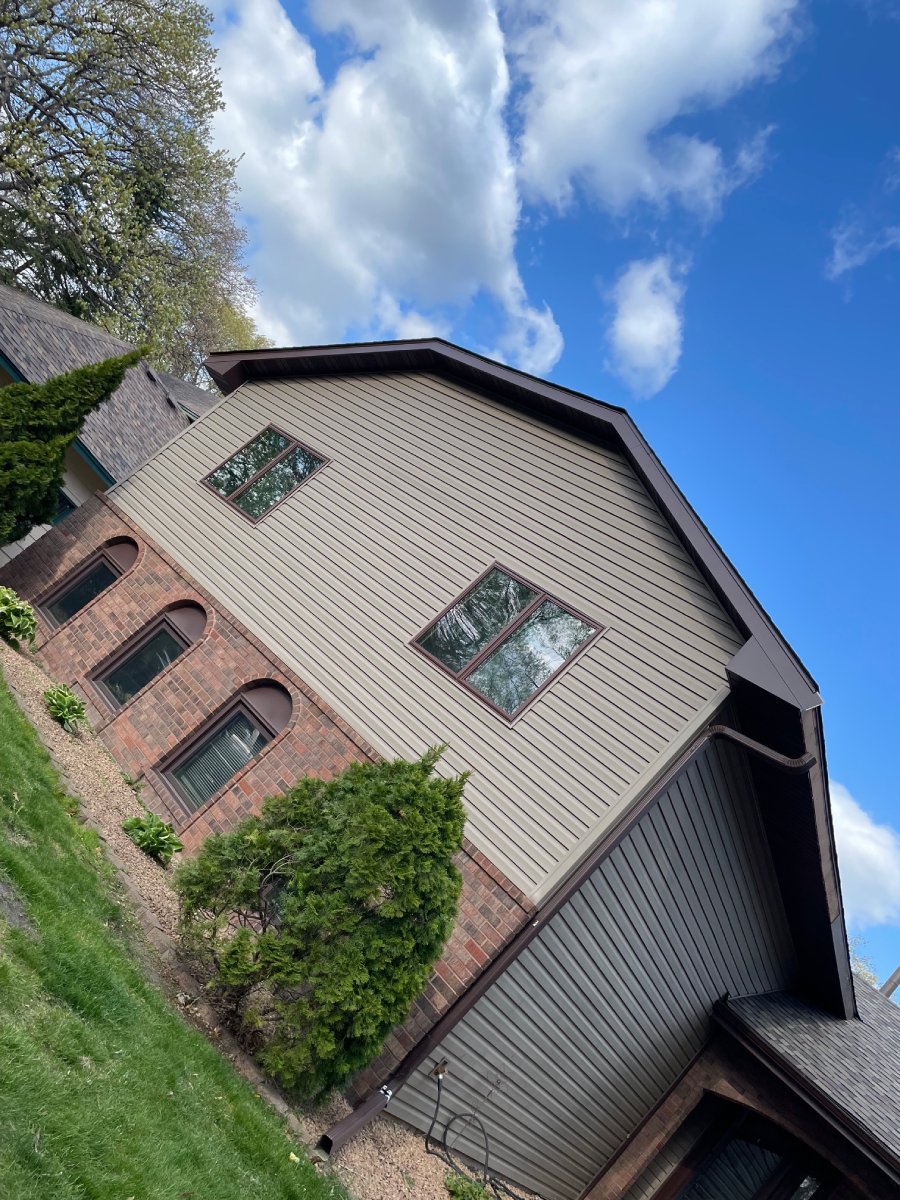
Storm damage on a Woodbury home rarely sits in one place, and the frequency of storms here means it often builds up across several before anyone notices. Here is where it shows, component by component.
- The roof. Hail knocks granules loose and leaves a dark spot where the mat shows through; wind folds shingles over, breaks the seal, and strips them at the ridge and rakes. With so many Woodbury roofs the same age, a middling storm can finish one already near the end, and repeated small hits compound the way they never would on a newer roof.
- The siding. Most Woodbury homes wear vinyl, some fiber cement. Hail splits vinyl, sometimes in cracks you catch only in raking light, and chips fiber cement. Wind pries panels loose at the corners and top course, where one can hang there looking intact while water works in behind it. Whichever way the wind ran that day sets which wall absorbed the most.
- The windows and trim. Shattered glass is the obvious case. The quieter damage is what gets missed: dented cladding, punched screens, seals that cloud over weeks later, and the trim framing each opening. That trim soaks up hail on these builder-clad homes and rarely reaches a first claim, so it earns a look of its own.
- The gutters, fascia, and soffit. Hail dents the trough and apron, which helps size the stones across the property; wind drags gutters off the fascia and pulls soffit from its channel. Once a gutter sits off level, it sets up the following winter’s ice dam, a genuine hazard on this housing stock.
- Everything else. The flashing, the vents, the condenser unit, the deck, and whatever outbuilding sits in the yard. A detached shed weathers the identical storm the house does, yet it is the single thing left off a scope more than any other.
Storm Damage, or Ordinary Wear?
A mark on the roof is not automatically a claim, and the point of an inspection is to tell the two apart before you file anything. On site, we run through five questions: how far the strikes reach across each slope, whether a matching shingle or panel is still made, the condition of the decking below, the years of service the roof still had in it, and whether a storm or plain age produced what we are seeing. That last one carries weight in Woodbury, where a whole generation of 1990s and 2000s roofs is wearing out at once, and age can easily pass for storm damage.
If it is a storm, we document it in full and see the claim through with you. If it is age, we say so, and a roof replacement scheduled on your own terms usually beats a claim the insurer turns down.
Woodbury Projects
Documenting the Claim and Working With Your Adjuster
Your adjuster can only pay for what the scope actually lists, which is why a thorough scope is the whole game. Coverage itself is the carrier’s call, resting on your policy, your deductible, and how they read the cause, and no honest contractor will promise you the result up front. What we will commit to is a full accounting. Every damaged element is shot and dated, the scope is written line by line, and one of our project managers meets your adjuster at the property so the two of them assess the same damage side by side. Should anything get overlooked, it goes back into the record in writing, with photos to match.
Our insurance claims assistance page covers the process in more detail. Before you sign with anyone, take note that under Minn. Stat. § 325E.66, it is illegal for a contractor to pay or rebate any slice of your deductible to win the work, so that offer tells you plenty about a company. And if you are deciding between repair and replacement, ask about Class 4 impact-resistant shingles, since many Minnesota carriers discount premiums for them, though whether it pencils out is a question for your policy.

Permits and Repairs in Woodbury
Woodbury handles storm repairs through a combination permit, folding roofing, siding, and window work onto one building permit instead of separate filings for each trade. The city can issue those over the counter, with the fee set by the value of the work and the number of squares, and the contractor has to be licensed and on file to pull one. The permit closes on a deck inspection and a final sign-off, and we hand you the closed permit when the job is done.
Most of master-planned Woodbury sits under an HOA, so exterior repairs usually need architectural review and sign-off on material and color before work starts, storm or not, and we open that early so it does not stall the job. And on homes built before 1978, lead paint is likely under the current finish; the city requires a lead supplement form unless the contractor is certified, and cutting into that paint calls for a certified crew. Advantage is an EPA Lead-Safe Certified Firm (NAT-F189197-2, valid through July 30, 2028), verifiable on the EPA firm locator.
Where We Work in Woodbury
We cover the whole city, the older homes around the original village core, the master-planned developments like Dancing Waters, the newer subdivisions filling in along the eastern edge, and the east-metro communities Woodbury runs into. Single-family, townhome, and the many association-governed neighborhoods in between, plus the sheds and outbuildings behind them. Past the city line, our service area reaches across the east metro, greater Minnesota, and western Wisconsin.
Other Exterior Work We Handle
A storm almost never limits itself to one part of the house, so we price the entire exterior in a single pass instead of leaving you to gather four separate quotes.
- Roofing, covering everything from bruised and wind-creased shingles to the decking, flashing, and ventilation, a tear-off reveals, plus Class 4 impact-resistant options where they suit the home.
- Siding, cracked and wind-loosened vinyl or chipped fiber cement, single panels or full elevations, matched to your color and cleared through HOA review.
- Windows, glass, and full units, plus the cladding and trim that take more of a storm than the glass.
- Gutters, new seamless runs, and downspouts set at the right pitch to keep the next winter’s ice dams from forming.
Why Woodbury Homeowners Call Us
Every roofing company will tell you it does great work. The ones worth hiring can show you the damage you didn’t know you had and document it well enough that your adjuster agrees.
- The HOA is our job. Master-planned Woodbury runs most exterior work through architectural review. We build and submit the application and secure approval before install day, so it never lands on you mid-repair.
- We read the whole exterior. Siding, window trim, gutters, soffit, and the shed out back all get inspected, because that is where a first claim usually leaves damage behind.
- We know the combination permit. Woodbury files roof, siding, and window work under one permit and closes it with a deck inspection. We handle the filing and hand you the closed permit at the end.
- We build the claim on evidence. Hail and wind damage gets photographed and dated, and we work with your adjuster directly, on your policy’s terms rather than promises about the result.
- We are here past the storm season. Minnesota-based, licensed as BC660998, and reachable in year six, long after the out-of-state crews have chased the hail somewhere else.
- Our credentials hold up. Owens Corning Platinum Preferred, EPA Lead-Safe certified, BBB A-rated, and 4.8 stars across 700-plus reviews. Bilingual project managers on staff.
Schedule Your Free Woodbury Storm-Damage Inspection
Book while the storm is still recent. Fresh damage is easy to tie to the event that caused it; wait, and you give your insurer room to call it wear. An hour at the house gets you a photographed log of every damaged part, a written scope your adjuster can build on, and a direct answer on whether filing makes sense at all. Have the storm date on hand, and if water is coming in right now, say so up front so we can bump you up the schedule. Contact Advantage Construction to book your inspection.
Frequently Asked Questions
Woodbury gets so many storms. How do I know which one damaged my roof?
You usually cannot tell from the yard, which is the whole reason to have it inspected. When storms roll through as often as they do here, the damage stacks up across several of them and may sit a full season without leaking. We record what is present and, wherever the evidence allows, connect it to a storm date, which is what a claim needs.
How soon after a storm should I get inspected?
The sooner the better, on two counts. Your policy sets a deadline to file, and damage that has not started leaking is far easier to pin to a particular storm when it is caught early. With how frequently Woodbury takes a hit, landing on the right date carries more weight here than almost anywhere.
My home is in an HOA. Does that change a storm repair?
It generally does. Most Woodbury associations want architectural review and a sign-off on material and color before any exterior work begins, storm damage included. We get that approval moving right away and carry the paperwork, so the review never becomes the reason your repair stalls.
Should I upgrade to Class 4 shingles when I repair storm damage?
It is worth a look. Class 4 impact-resistant shingles stand up to hail better than standard ones, and a good number of Minnesota carriers trim your premium for installing them, a fit for a city that draws the hail Woodbury does. Whether the discount and the extra lifespan justify the higher price comes down to your home and your policy, so confirm the discount with your insurer.
Will insurance cover the damage?
That comes down to your policy, your deductible, and how your carrier reads the cause. Wind and hail are usually covered perils, though a number of Minnesota policies apply a separate wind-and-hail deductible. We document the loss in full; the coverage decision rests with your insurer.